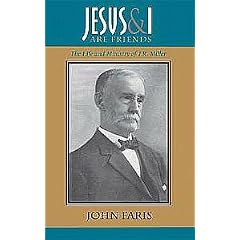
The subtitle here is "The Life and Ministry of J.R.Miller."
I first came to know of James Russell Miller (1840-1912) through a book titled "Home-Making" many years ago. It was an exposition on the ideal Christian family life, and I was enthralled by it, stirring within me a desire that my own home would be like that someday. Several years passed and then I "chanced" upon an old book I found on the top shelf at "Charleville," the house I lived in for two years in Ireland. They had quite the library at this house, and I was drawn to the books on the top shelf because they were beautifully bound, all first editions, from the late 1800's. Well, I started reading this book titled "Life's Byways and Waysides," with its short chapters, filled with poems, exhortations of comfort and love, stories of ordinary people doing everyday kindness, and examples of Jesus and His followers walking in His steps. Everytime I read a portion of the book, I went away with a desire to show love to those around me and I was drawn to a pure way of life.
So, when I discovered recently there was a biography of J.R. Miller, I found it on Amazon and ordered it immediately. It has been a great encouragement to me to learn about the life of the man behind at least 60 devotional books, and various other writings. Some excerpts now:
(On his early work with the Christian Commission during the Civil War years)"'During the campaign the twofold object of the Christian Commission has been kept steadily in view. While caring for the body, and labouring to alleviate bodily sufferings, we have aimed to lose no opportunity to speak a word for Jesus. We have always borne in mind that our soldiers are beings for immortality; and, in going from cot to cot, among thousands, our delegates have not failed to remind them, if but by a hastily spoken word, that they have interests far higher than those of time. Prayer meetings and other brief religious services have been regularly held in all our hospitals; and a quiet, but powerful, work of grace has been constantly moving forward...The world will never know the nature, value, or importance of the work performed in the hospitals by our delegates. It was quiet, unostentatious work of mercy. Entering on their labours there in a time of greatest suffering, they worked by day and by night among the wounded thousands, washing, dressing, feeding, praying with the dying, burying the dead, and calling upon the living to repent and be saved.'" (pg.47-48)
"His ordination and installation took place September 11, 1867,[in Pennsylvania] and he at once devoted himself heartily to the work of pulpit and pastorate...From the first there was a persuasiveness in tone and message, and an earnestness in utterance which made his preaching--to use the words of an admirer--'peculiarly his own.' There was nothing stilted in his pulpit work, no straining after rhetorical or dramatic effect, but there was a simplicity, a directness, an elegance and richness in dictation and illustration, combined with the evident sincerity and earnestness that carried his messages directly to the heart." (pg.71)
"On June 22, 1870, Mr. Miller was married to Miss Louise E. King of Argyle, New York, whom he had met in May, 1868, while attending the meeting of the General Assembly of the United Presbyterian Church in Argyle. From the day of his marriage Mrs. Miller was his inspiration and his helper in all his work. He was never weary of telling of his great debt to her. In his letters to young married people, he frequently told of what she was to him, and said that he could wish them no greater happiness than a home such as she was making for him. The secret of Mrs. Miller's helpfulness was not only her beautiful character, but her recognition of the fact that her husband belonged to those who listened to his preaching, who received him in their hom, who read the publications he edited, or who were inspired by his books. That he might be free to serve them she saw to it that he was relieved of all home cares which she could take upon herself. In these efforts she was most successful." (pg.76)
(a letter he wrote to a young pastor in 1910, who was seeking advice--and Dr. Miller evidently lived what he preached.) "'Cultivate love for Christ and then live for your work. It goes without saying that the supreme motive in every minister's life should be the love of Christ. "The love of Christ strengtheneth me," was the keynote of St. Paul's marvellous ministry. But this is not all. If a man is swayed by the love of CHrist he must also have in his heart love for his fellow men. If I were to give you what I believe is one of the secrets of my own life, it is, that I have always loved people...If you want to have success as a winner of men, as a helper of people, as a pastor of little children, as the friend of the tempted and imperilled, you must love them and have a sincere desire to do them good.'" (pg.87)
(what Louis F. Benson,D.D.,who was a fellow boardmember with Dr. Miller on the editing of numerous Christian periodicals, had to say about him)"He addressed literally millions of people, and each one of them felt his personal touch and was conscious of the ministry of love. He had only one theme, the beauty of being better than we are. It is said that he repeated himself; and that saying probably reveals one of the secrets of his success. He was no more afraid of repeating himself than life itself is." (pg.142)
(an excerpt from a letter he wrote to a stranger who was suffering) "'Your stationary shows that you are in sorrow. I may not intermeddle with your grief, but I may say at least that my heart goes out in sincere sympathy to you, whatever the greife may be which has touched your life. No doubt you have learned that sorrow is a great revealer. We never should see the stars in the sky, if the sun kept shining always; and the Bible is like a sky full of stars--stars of comfort, of divine revealing, of spiritual help, of which we never should know experimentally did not the sun go down for us and the darkness come on. Very much of the Bible remains like a sealed book to God's children until they are called to pass into the shadows of grief. That is what our Master meant in the Beatitude for sorrow, "Blessed are they that mourn, for they shall be comforted." Comfort is one of God's highest and best blessings. But we never can have comfort till we mourn.'" (pg.175)
(and another letter he wrote) "'Love is never lost. Nothing that love does is ever forgotten. Long, long afterwards the poet found his song, from beginning to end, in the heart of a friend. Love shall find some day every song it has ever sung, sweetly treasured and singing yet in the hearts into which it has breathed. It is a pretty legend of the origin of the pearls which says that a star fell into the sea, and a shellfish, opening its mouth, received it, when the star became a pearl in the shell. The words of love's greeting as we hurry by fall into our hearts, not to be lost, but to become pearls and stay there forever.'" (pg.204)
~~recommended, along with J.R. Miller's various devotional books
(originally published 1912 by Hodder & Stoughton; this edition by Solid Ground Christian Books)
