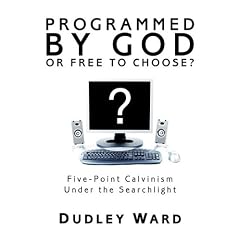
The subtitle here is "Five-Point Calvinism Under the Searchlight."
In the preface, Mr. Ward states, "I have come across many [people] desperately seeking an answer to the knotty question as to whether it is God's own predetermined choice alone that decrees who will be saved from eternal doom, or whether the genuine, free response to God of each individual has a crucial influence in the matter." And later, "In attempting a brief survey, I am writing for very ordinary people who are troubled by the TULIP teaching, that they might find release into a warmer and more intimate understanding of the true extent of the love of God in Christ. Let us never forget, however, that our degree of intimacy with the Person of Christ is even more important than our zeal in propagating our views on these matters." I believe that the author does a brilliant job of exactly what he set out to do.
He holds that the best way to examine a certain idea is to ask questions about it. So, each of the chapters are a question dealing with the doctrine of Five-Point Calvinism, commonly known as TULIP (Total Depravity; Unconditional Election; Limited Atonement; Irresistible Grace; Perseverance of the Saints). Some of the chapter titles are: "Does God Want to Save Only the Elect?" ; "Is Everybody Able to Repent?" ; "What is Foreknowledge?" ; "How Merciful is God?" ; and "What is the Perseverance of the Saints, according to TULIP?"
Mr. Ward tackles the difficult Scripture passages (Ephesians 1, anybody? :-) and comes out on the other side giving us a plain understanding. I have learned that we subconsciously interpret Scriptures in a certain light, whether we are aware of it or not. This is something that takes guarding against and a rallied effort to overcome. I have learned the importance of knowing the Greek and Hebrew words used in particular passages and reading things in their correct context. I have come away from reading this book with a joy and assurance in my heart, an overwhelming gratefulness for God's great love, yes, for the whole world!
Now, for a few quotes:
"Predestination refers to the goal, the destination that God fixed in eternity past for believers in Him. Consequently, our predestined goal is not about God's work of saving us, but about our becoming brothers and sisters of Jesus, being transformed into His likeness and living for His glory. Whereas predestination is not speaking about which specific individuals God will choose to save, one of its purposes is to comfort believers with the knowledge that the Lord firmly established for us the goal of Christlikeness...God fixed, right from the beginning, the nature, quality, and destiny of the authentic Christian life...Predestination is not about who is destined to become a Christian, but whom a Christian is destined to become. " (p.17-18)
"To a Calvinist, for whom God's sovereignty would be demeaned by the admission that man can and must freely choose to respond to God's offer of salvation, we must ask the following question: Would not His sovereignty also be diminished by the need for Christians to freely choose to continue to walk in God's way? Yet, as believers, we work out our relationship with Him in godly fear and trembling, cooperating with Him in the ongoing process of sanctification...God does not do what He calls us to do in the working out of our practical transformation. He has an unlimited and all-sufficient supply of help there for us to draw on at all times in our pursuit of holy living, but we ourselves have to learn the discipline both of availing of His help, and of applying ourselves to obeying His commands." (p. 72)
"We can rest in the assurance that the wonderful grace of God is worldwide in scope and that His immense mercy will triumph over judgment. According to Revelation 5:9, souls will be present in heaven from every language and tribe on earth, yet as far as we know some tribes have become extinct without being evangelized by Christians. The scope of God's redemptive work is unmistakably far greater than we can ever imagine." (p. 103)
"God's sovereignty is one of Scripture's greatest themes, but the love of God, not His sovereignty, is the cardinal theme of Scripture. We are ambassadors of His kingdom of love and light in this darkened world, and we can shine forth the visible reality of the fullness of His presence within us: 'And to know the love of Christ, which passes knowledge, that you might be filled with all the fullness of God' [Ephesians 3:19]. There is in fact only one gospel, the good news that Jesus died for all men, revealing the Father's great heart of love." (p. 114)
~My most highly recommended book of this year, by far! So, go get it now, and the best part is, you can find it on Amazon.com.
2008, Resource Publications