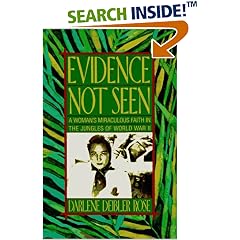
The subtitle here is "A Woman's Miraculous Faith in the Jungles of World War II." After having read this book once before (when I was 13 or 14 years old) and also seeing a video of Mrs. Rose share her story, I was planning to only skim back through it enough in order to refresh my memory and write a review of it. Well, I was crying as I finished the last few pages yesterday, reading of Darlene's reunion with her family after a war and world apart for 8 years. "Evidence Not Seen" has been an inspiration to me in many ways, including how I view difficult circumstances. Here was Darlene, in her early twenties, in a Japanese P.O.W. camp, and she is able to laugh and be grateful for what tasted like "yummy chicken soup." As it turns out, their watery rice gruel, cooked in old kerosene containers, had a dead rat and bird in it. Instead of complaining, she and the other women gave thanks for the added protein and the flavor that covered up the usual bitter kerosene aftertaste. Would I be able to do that?
I was reminded of the adventures that Darlene and her husband encountered as they were pioneer missionaries in New Guinea. But, I also remembered the horrible trials that Darlene had to endure on her own, along with the other women in her camp, and when she had to spend several months in solitary confinement. It was during these emotionally and physically draining times that she felt ready to break in two, but she fed on God's Word which she had memorized in her heart. There were also many Christian hymns and poems she would quietly sing and recite to herself.
I highly recommend this book to everyone, providing only a warning that there are some events described that may be too graphic for some younger folks. Bear in mind this was war time, Japanese POW camps, and some very "uncomfortable" illnesses passed around.
Published by HarperCollins, 1988.
